And the award goes to…

It’s that time of the year again. That lull between Christmas and New Year when news editors fall back on reviews of the year just gone and best-of lists to fill column inches. For myself, it’s an opportunity (or an excuse for self-indulgence) to look back over the concerts I’ve been to in the year, to see which ones I remember and which make me say “Did I really go to that? I don’t remember it at all.”

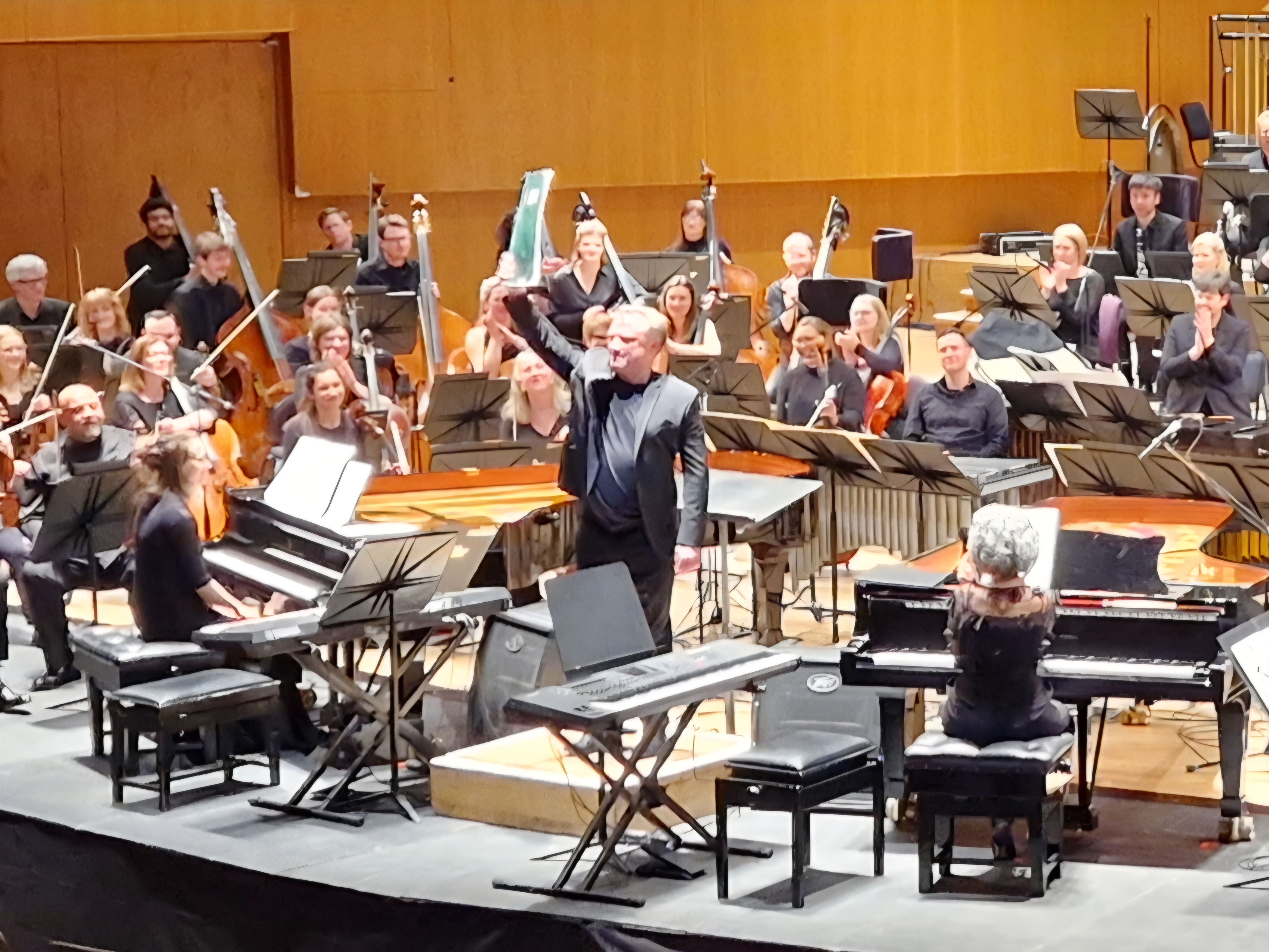
It was a pretty good year for those perennial favourites Mahler and Shostakovich, beginning in January with a memorable Mahler 2 in Manchester from the Hallé and their new principal conductor Kahchun Wong, while John Storgårds continued his exploration of Shostakovich with the BBC Philharmonic as well as giving us an exceptional Mahler 3 in June. Above all it was a good year for minimalists: Glass’ Satyagraha in Nice, a feast of John Adams in London, Berlin and Manchester, and Colin Currie rounding off the year with Steve Reich in Manchester.

Colin Currie brandishing the score of Steve Reich’s The Four Sections

But which concerts stand out the most? Let’s get the bad out of the way first.

Most Disappointing Concert of the Year

There are a few candidates for this raspberry. Nicholas Collon is a conductor I admire enormously, and the Orchestre Philharmonique de Monte-Carlo is a fine orchestra, but their concert in April really didn’t work. On paper it was an excellent programme of Debussy, Poulenc and Bartok, but orchestra and conductor just didn’t gel. You could see it in the body language. Who knows why this sometimes happens, but it was a shame.

Still, that doesn’t take the crown. For that we have to look to the Proms. Perhaps it was my fault, perhaps I chose the wrong concerts, but of those that I went to only John Storgård’s semi-staged account of Shostakovich’s Lady Macbeth of Mtsensk District lived up to my expectations. The Arvo Pärt 90th birthday concert disappointed as well, though that may be simply that my expectations were too high, but the winner – insert sound of envelope being opened – was the Vienna Phil and Franz Welzer-Möst with Berg’s Lulu Suite and Bruckner 9. Beautifully played, of course, but oh so bland. Utterly unmemorable, but for the fact it was so disappointing.

Best Jazz of the Year

A new award this year, but it’s been a good twelve months for jazz. A couple of excellent evenings in London tacked on to visits to the Proms: Denys Baptiste led a McCoy Tyner tribute, and the Hungarian (but London-based) pianist Matyas Gayer was a discovery. Buxton may not seem an obvious jazz centre, but the Buxton Festival always has a jazz festival within, and Xhosa Cole playing Thelonius Monk was the highlight there.

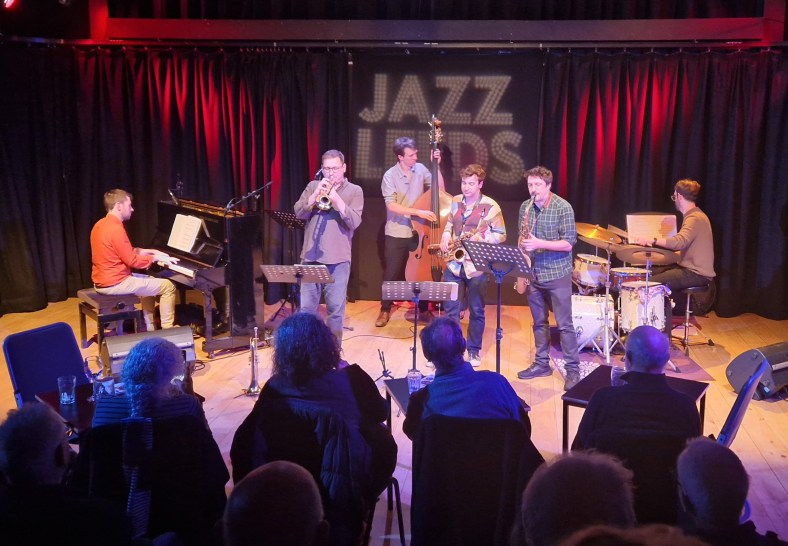
But best of all was in Leeds. I’ve always wanted to hear Misha Mullov-Abbado live, but in the past whenever he’s been playing near to where I live, events have conspired against me. This time I was not to be defeated. His latest album Effra is stunning; contemporary in feel and yet with clear links to tradition. Leading his sextet from the bass like a modern Mingus or Ray Brown, it was a wonderful evening. And yes, that name: Mullov-Abbado. Perhaps being the son of violinist Viktoria Mullova and conductor Claudio Abbado he was always destined for a life in music, but he really is supremely talented in his own right.

Misha Mullov-Abbado and friends

Most Surprisingly Enjoyable Concert of the Year

This may seem a strange category, after all, why go to a concert if you don’t expect to enjoy it?

But some concerts exceed expectations, and this was the case with the Orchestra of Opera North in May at Huddersfield Town Hall. Their Huddersfield concerts are always a pleasure and they often have big-name soloists. The town hall is quite small as an orchestral venue, with the balcony wrapping itself around the stage, and the result is often a sense of intimacy that compensates for the challenge the orchestra often has trying to fit everyone on stage.

What was unusual about the May concert was that it concentrated on the core members of the orchestra. Generally, to play full-scale concert repertory they have to bring in a large number of extras, but for this programme of Prokofiev, Schumann, Anna Thorvaldsdottir and Haydn they weren’t needed. There wasn’t a conductor, with the orchestra being led from the first desk by Katie Stillman, and even the Schumann Cello Concerto was played by the principal cello, Jessica Burroughs.

Perhaps this reduced scale was a consequence of financial expediency, but the result was a tremendous sense of family and camaraderie. The players really enjoying themselves, playing for each other and showing what they could do. Ten out of ten.

Concert of the Year

Drum roll please. Time for the big reveal.

In any other year it would have to be the Berlin Philharmonic with Simon Rattle playing John Adams’ Harmonielehre. A visit to the Philharmonie had long been on my wishlist, and when a window of opportunity opened up in October I might have gone regardless of the music, but that they were playing one of my favourite pieces was an incredible stroke of good fortune and Rattle has always been an excellent advocate for Adams. It was interesting to contrast this performance with that of John Wilson and his Sinfonia of London who gave a terrific account at the Proms in 2024. Simplistically, with John Wilson there was more of an emphasis on the music’s American twentieth century credentials, with the Berliners, and in particular the depth of sound from their strings, the nineteenth century roots were more obvious.

But no, wonderful though that was, the Berliners are only runners-up.

Sleep

 I’ve written about it before so I won’t go on at length, but hearing Max Richter’s Sleep at Alexandra Palace at the beginning of September was something else. Memories that are still with me and will probably never leave. An experience unlike any other concert.

Reading the World: Books in Translation

Whenever we are spending time at our home in France I enjoy browsing the bookshops, and in Nice there are at least three good independents that I know of. Not that I buy many books when I’m there because my French isn’t really good enough. I can just about manage a crime novel if I’m prepared to take my time with it and have a dictionary to hand. Books with a lot of dialogue are easier for me than anything with long, convoluted sentences. Proust is a no-no.

But what always strikes me is the range of general fiction that is available in translation. Particularly books translated from English to French. And it’s not just the classics – Austen, Dickens and so on – but many recently published books, from contemporary literary fiction to more mainstream writers, and plenty of genre fiction: crime, SF/Fantasy, romance and YA. All this is laid out on tables for easy browsing, not hidden away in a special section on the third floor. I even have a friend in England whose first novel was published in its French translation before it came out in the UK.

This is a remarkable openness to foreign literature, all the more impressive (perhaps even surprising?) coming from a country that is justly proud – and indeed protective – of its own culture, and I wonder whether in the UK we have the same interest in writing from other languages? To a degree perhaps, certainly Murakami and Knausgaard are easy to find in Waterstones, but less celebrated writers? Genre writers? No doubt there are others that I’ve missed, but apart from the piles of increasingly derivative Scandi noir, I’m not so sure. Where is the French science fiction or the Portuguese crime?

If in the UK mainstream publishers and retailers hesitate to offer books in translation, what we do have instead are some excellent small indies that specialise in bringing the best writing from wherever to Anglophone readers. Pushkin Press and nordisk books (the lower case is not a typo) are two examples, but one that I would like to celebrate here is Peirene Press. Over the last few years, they’ve introduced me to novels by writers from Georgia, Latvia, Lithuania, Chile, Egypt, France, Sweden and Norway. You can buy their books individually, but what I appreciate is their subscription model where for a single annual payment I get three books a year. I don’t think I save much (if anything) this way, but what it means is that I read books I probably would never have considered buying normally.

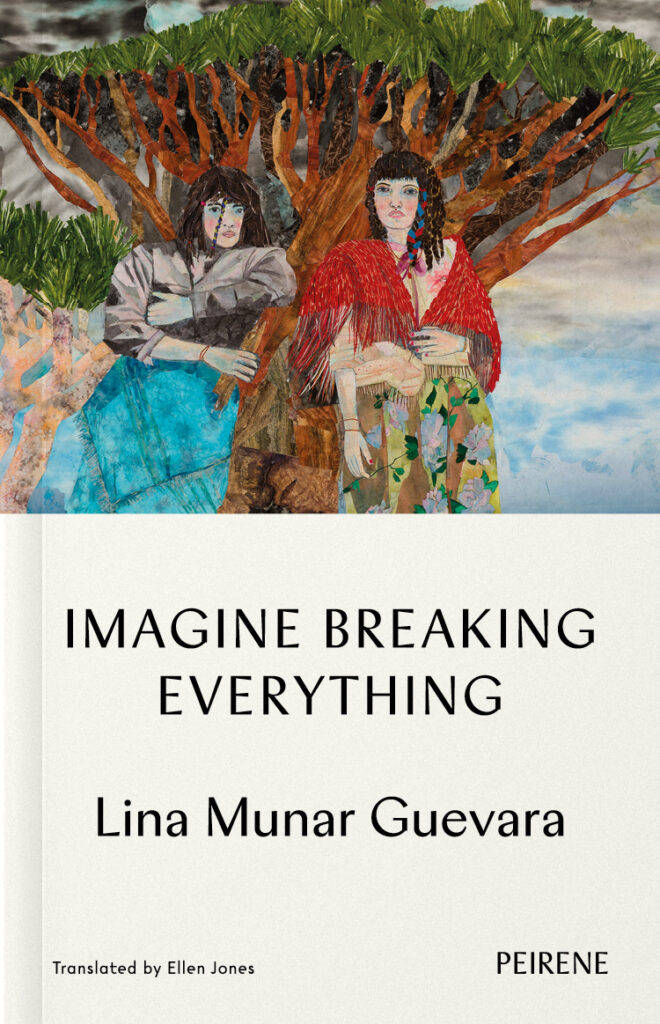
I’ve just finished Imagine Breaking Everything (Imagina que rompes todo) by the Colombian writer Lina Munar Guevara, beautifully translated by Ellen Jones. Link here Peirene Press – award-winning independent publisher. This tells the story of the 18-year-old Melissa and a weekend she spends with her slightly estranged mother.  Melissa is hoping to graduate from high school and go to college (there are complications) and is such a well-written character. She is deeply flawed and prone to acts of violence – and we learn why, it’s not really her fault – but her honesty and self-awareness mean that we root for her nevertheless. She is also very funny. There is terrific writing from Lina Munar Guevara; one sentence in particular impressed me in the way that in a mere six words the reader is very cleverly told a key (and quite unexpected) plot point. I was left gasping in admiration for the skill with which that was done – but of course I can’t tell you more. Too much of a spoiler!

There’s nothing like literature to show you other people’s lives, we all know that, but it is even more the case with books in translation. Perhaps I don’t need to know what it is like to be a young woman in Bogotá and what daily life is like in a less than salubrious suburb, but my life is richer for having spent time in Melissa’s company.

I hope she did make it to college in the end.

On Silence

I’ve been thinking a lot about silence lately.

Of course, as John Cage taught us, absolute silence does not exist so perhaps I need to define my terms, but silence as we commonly understand it, extreme quietness perhaps, seems to be something that most people appear anxious to avoid, almost as if they were afraid of it and feel the need to keep it at bay with empty talk, banalities that blanket the sound of time’s wing’d chariot. Restaurants – even the finest Michelin-starred establishments – play background music, train journeys are accompanied by the modern scourge of music from phones (I’ve even seen people doing that on country walks). On a recent trip to London one woman talked at (not to) her companion for three hours straight (and how did her friend feel about that?).

What is it that people are so afraid of? Their own thoughts? Do they equate, if only subconsciously, silence with emptiness? The void? The silence of the grave?

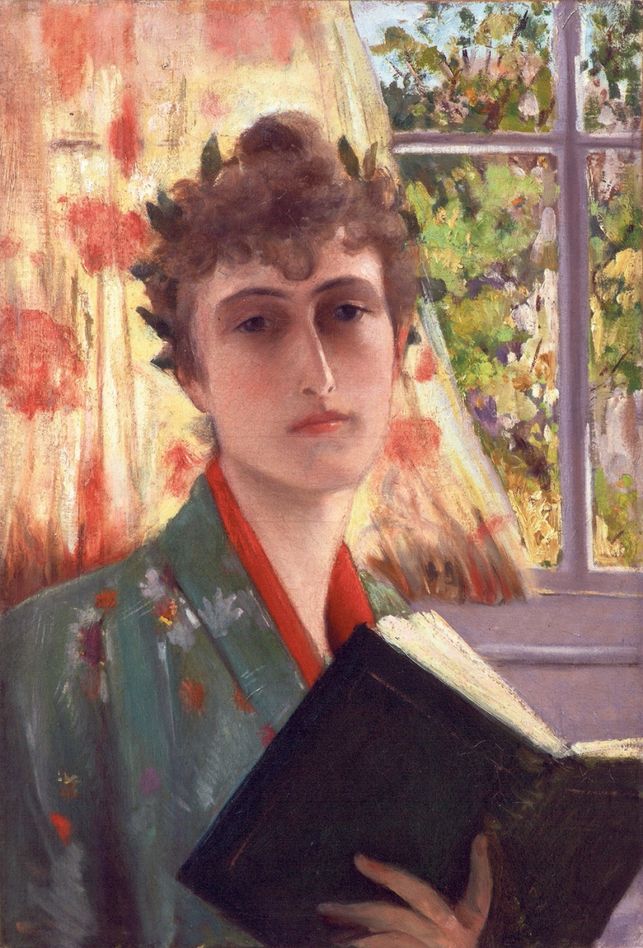
Fernand Knopff, Silence, 1890

I love silence, quietness at least, though I appreciate that this does nothing for my social life, and I am certainly no fun at parties. But silence gives space to reflect and consider, and it’s no surprise that most religious traditions recognise the value of time spent in silence. I love the way it comes in different guises, quite different from each other: the silence of late at night is the sound of the day’s energy dissipating, while the quiet of dawn – depending on the amount of birdsong! – is pregnant with possibilities. The silence of the new, the day as yet untarnished, not yet spoilt by the inanities of modern life.

It was Debussy who said that the music lies in the space between the notes. An elusive comment for sure, much like his music, but consider the tension that rests in the air between the final chords of Sibelius 5 – and the fact that they are irregularly spaced only adds to the effect – or countless examples where composers leave brief pauses. Think of a piece as well-known as the slow movement from Dvorak 9. Don’t simply listen for the famous tune, listen for the silences that are coloured by the notes that come before and after. The silence is never empty, but is shaped by what surrounds it. It is a positive absence of notes that makes it musical material in its own right.

Silence in literature is an even more complex – and paradoxical – issue than it is in music. Silence on the stage is a standard effect – Pinter being only the most famous – but how do we talk about silence in novels? Characters may be silent, and silence (hesitations, ellipses) can be a key part of writing good dialogue – and what a character doesn’t say is often more important than what they do – but can fiction itself be silent, and not merely quiet as in understated? The French writer Pascal Quignard says that “The book is a piece of silence in the hands of the reader.” I like that. I also like Graham Swift’s echo of Debussy when he wrote that “the spaces between and around words can have their unspoken resonances”. I feel sure I’m going to come back to this.

So, a plea for more silence – or at least quiet – in the world. Enjoy the aesthetic qualities of silence itself and how it is shaped by and shapes in return the world around it.

And remember Wittgenstein: whereof we cannot speak, we must be silent.

Ghosts

Nick-D, CC BY-SA 4.0 https://creativecommons.org/licenses/by-sa/4.0, via Wikimedia Commons

There are ghosts in Hong Kong and we walk among them whether we realise it or not. These are not the spirits of the Hungry Ghost Festival beloved by the tourist board, recipients of burnt offerings bought from the shops in Western. These are different ghosts and memories that are being quietly forgotten by the simple expedient of not being spoken about. We pass by and never see them. Unless we stop and look, take a moment to remember, they remain invisible. 

There are ghosts in the hills above Tsuen Wan, but If you’re hiking the full 100 kilometres of the Maclehose Trail, then by the time you reach the remains of the Gin Drinker’s Line you’re hardly in a condition to pay much attention to a concrete tunnel entrance, even one with the unlikely name of Haymarket or Regent Street neatly carved into the stone lintel. There’s even a Shaftesbury Avenue but don’t expect the bright lights and theatres of the West End. By that point you will have been hiking for hours, and unless it’s winter you’ll have been feeling the heat and high humidity as you deal with Needle Hill and the climb over Tai Mo Shan. You’ll be far more concerned with the blisters and chafing to be bothered with what remains of an attempt at replicating the Maginot line and one that proved to be just as unsuccessful. 

The ghosts are also there when you take a Sunday stroll through Pokfulam Country Park and watch children playing on the old gun mountings. They are present in multitudes if you take a short detour off Shek O Road to the Sai Wan war cemetery – but who does that on a hot summer’s day when the beach beckons or you’re planning to go surfing at Big Wave Bay? And when the minibus is on the final stretch into Shek O itself, do people see the spectres that are said to haunt the country club? 

But above all there’s the single ghost who sleeps outside St John’s Cathedral. On weekdays office workers pass by oblivious to him. On Saturdays everybody heads for the shopping malls of Central, while on Sunday worshippers pay him no attention and Filipina maids spend their one day off picnicking nearby. He’s been there so long he no longer registers. 

Ronald (Roy) Douglas Maxwell was 22 when he was killed on December 23, 1941 – and his is the only grave in the Cathedral grounds, shaded from the summer heat by a tree; a simple gravestone surrounded by a low chain. The story goes that he was buried in a foxhole that had been dug in Cathedral grounds. During the occupation the Cathedral was trashed and used as a club for Japanese officers – but were they being watched all the time by Roy’s ghost? Perhaps he was spying on them. Or perhaps his very presence was the bad fung shui that three and a half years later brought an end to the occupation. They never knew they were doomed from the start; Roy’s final act of defiance against the invader was to haunt them until they were gone in ignominy. And to him they were an invader of his home. 

These days it is fashionable to paint the picture that the likes of Roy Maxwell were colonial imperialists, but he was born in Hong Kong. Eurasian with a British father and Chinese mother, he was just one of many like him who died in December 1941 and whose allegiance was to Hong Kong. But in 2024 where a new patriotism is everything, is it still possible to remember Roy and his comrades? Those who gave their lives for the place where they were born? Are we allowed to honour them or are they being quietly forgotten? 

Twenty-four years ago I was married in St.John’s and there are photographs of that hot sunny June day taken outside the Cathedral. The obligatory formulae: Happy couple with bride’s family, happy couple with groom’s family. With friends, with everyone. Do any of the photographs include Roy Maxwell? Is there a shadow in the background perhaps? I’d like to think so. I’d like to think that he has shared in all the joy and sadness that the Cathedral has seen since the day he was laid to rest. 

We forget our history by not talking about it. To be silenced, to not be spoken of, is a second death. There are still ghosts in Hong Kong and we should remember them. 

On The Perils Of Not Being Able To Plot

I have decided that I hate those writers who plot their novels in advance to the last detail; writers who have precise storyboards showing every last nuance of the story, writers who have written lengthy biographies of all their characters before they start.

Well I don’t hate them of course. I’m just very jealous. I am incapable of doing that. I start with a general idea for what the novel is going to be about, but only by the act of writing itself can I generate plot ideas, and only be writing can I find out who my characters are.

Which is all very well, but it comes with a price.

I’ve just finished a first draft of a new novel. It has come in at only 70,000 words, but that’s okay because later sections are a little skeletal: there wasn’t much point in expending a huge amount of effort on them when I know how much needs to be revised or added in the second draft because I didn’t properly plot in the first place.

Take the ending. When it came to the final chapter I suddenly discovered that my narrator needed access to a boat. Stealing a boat would be out of character, chartering one unrealistic in the context, so he is going to have to own one. For this character it is perfectly plausible that he might, but I’m going to have to write various chunks to explain this so that the boat doesn’t appear out of nowhere as a deus ex machina!

Then there’s the little matter of how the entire thrust of the novel has changed. To the extent that I had planned it, I had a main storyline and one subsidiary. Of course the subsidiary idea has proved far more fruitful, and in particular one minor character (barely more than an incidental figure on the sidelines in the early chapters) has completely taken over the book, so she will need to be introduced more thoughtfully than before.

Oh well, lots to do in the second draft.

My next novel will feature a frustrated writer who becomes a serial killer tracking down all those smug novelists who have more control over their characters and their fate.

On the Importance of a Unique Voice

Today is John Cage’s birthday, a composer whose music I find myself turning to more and more as I get older, a composer who devoted so much of his work to questioning our assumptions about music, and a composer who has made me ponder one of the mysteries of my own response to music.

Over the years I have unconsciously developed a test for whether a composer is worthy of my further attention or not: Does he or she have an individual voice that marks them out from others? You can use this test with music of any period old or new, and indeed it can be extended to other genres of music such as jazz, though then I normally ask the question of the performer rather than the composer. I am picking my words carefully. Worthy of further attention is not the same as like. There are plenty of composers whose music passes that test, and who are undoubtedly important in the history of music, but where I struggle to say that I enjoy them. Liszt, Rossini and Verdi for example. Equally there are minor composers who do not have that special something, but who have written at least some pieces that I enjoy regardless. Guilty pleasures such as Saint-Saens’ Organ Symphonyand d’Indy’s Symphonie sur un Chant montagnard français.

Musicians and others more expert than I am can probably explain why Mozart has a different voice from Haydn, Schubert from Schumann, Shostakovich from Prokofiev, but from years of listening I think that I have a good ear for identifying the composer when it is a piece that I don’t know. Sometimes of course you get other clues. Once when driving I turned on the radio and found myself in the middle of a violin concerto that was clearly mid-twentieth century and probably Russian (or Soviet anyway) but wasn’t one that I knew and therefore I could rule out Prokofiev and Shostakovich. The soloist was evidently brilliant but the recording quality less so and perhaps dated from the late 50s early 60s. Adding those facts together surely it had to be David Oistrakh? So, I asked myself, what other composers were there that Oistrakh championed? Khatchachurian? Correct on both accounts as it turned out, though I think I might have been lucky.

You may be wondering what any of this has to do with John Cage, seen by many as the ultimate avant-garde crazy composer of silent pieces, chance operations and general wackiness? I have listened to a lot of Cage over the years, both on CD and in concert, and what has struck me is that he is an example of a composer with a unique voice (or perhaps several different voices) even though in some of his music – particularly the music that involves chance elements – his stated aim has been to remove the composer from the music and to allow the sounds to exist independently from the composer’s ego. That is the mystery for me. Even when Cage uses the most extreme aleatoric elements, such as using the I Ching, star maps, or even flaws in manuscript paper to derive the notes, it still ends up sounding like John Cage. How can that be?

One of my favourite Cage discs is a CD of vocal works performed by Paul Hillier and his Theatre of Voices. The main work is the haunting Litany for the Whale which gives the disc its title and which could be enjoyed by anybody who likes the music of Arvo Pärt or John Tavener. The track I enjoy the most though is Experiences #2 which is one of the more misleading titles in music, giving the impression of a difficult obscure over-complicated piece when the reality is very different. Experiences #2 is an exquisite setting for solo voice of an e.e. cummings poem, highly modal, sung with very little vibrato, and with an almost folk-like melody. So why does it sound like Cage and nobody else? I don’t know though perhaps it is the extended silences between the musical phrases that gives it away.

The Value of Persistence (Again)

I’ve written before about the importance of persistence and never giving up, and yet I still sometimes forget about it.

Last year I put in an enormous amount of effort into writing a story that needed to be set on the North West coast of England. Not a part of the world I knew particularly, but the setting was a requirement for submission to a planned anthology. It took me quite some time to come up with a story idea, set in Morecambe, one that I could latch onto and thought that I could do justice. A first draft appeared and a friend read it and said: “It’s very good Graeme, but it reads as if you have never been to Morecambe.”

It was a salutary reminder that you can’t learn everything about a place from Google Images. So I took myself off to Morecambe, walked the back streets, poked my head down alleyways, and the second draft was so much better. Thrilled with it I submitted the story, quietly confident of acceptance. Well, reasonably hopeful anyway – so much so that the subsequent rejection was more than a little disheartening.

But once that initial despair had died down, I didn’t give up and thanks to the wonderful people at Litro Online “A Love of Numbers” found a home. Enjoy it here if you’d like to read it and tell me what you think. Was I right to persevere?

A Love of Numbers

André Cluytens: In memoriam

We all know how unreliable childhood memories can be. Those remembered long hot summers when in fact it rained all the time; those happy family holidays when we have wiped from our memory the arguments and bickering. And the books, music and TV programmes of our youth? How often do they live up to our recollection of them? Hardly ever.

Starting to grow my record collection as a schoolboy in the 1970s, I was constrained by the limitations of pocket money that over a few years ranged from £1 per month to £3 – partly depending on a highly complex algorithm designed by my father that linked financial rewards to school grades. I used to get the money on a Friday evening, and then by Saturday lunchtime it had been spent in the local record shop (remember those?). This meant one LP a month that had to be chosen carefully to get the most out of my limited resources; make a bad choice and I was stuck with a lemon and a whole month to wait before I could buy anything else. And they weren’t cheap, not in real terms compared with today. With a new full-price LP costing around £2.99 – going up to £3.25 for a Deutsche Grammophon release (you had to pay extra for that smart yellow label with the tulip crown) – I needed really kind teachers to afford anything other than the budget labels such as EMI’s Classics for Pleasure, which is where I discovered André Cluytens’ Beethoven. Not that I knew or cared who André Cluytens was, I just wanted to buy some Beethoven symphonies.

With the original LPs long lost, I can’t say with certainty which I bought, but they definitely included the Eroica, Pastoral and the Seventh – all from his Berlin Philharmonic cycle recorded in the late 50s right at the beginning of the stereo era (and interestingly that means it’s the Berlin Phil pre-Karajan). A warm memory of those recordings has stayed with me over the last 40 years, recordings that first enabled me to really get to know Beethoven. So it was with a little trepidation that I recently bought the symphonies again on CD (about £10 for the set – how times have changed), and with no little joy to discover that in this case my memory was correct. They still give enormous pleasure all these years later, even with a CD collection that includes complete cycles by the likes of Furtwängler, Brüggen, Rattle, Gardiner, Abbado, and Böhm, as well as countless individual recordings. They are immensely civilised performances, no suggestion of a Cluytens style or sound, he simply lets the music be itself, and even the recorded sound is better than many later recordings.

André Cluytens died fifty years ago this month. The teenage me didn’t know him from Adam, and he’s still not really remembered in the same way as someone like, say, Fritz Reiner, but he should be.

On the embarrassment of being late to the party

Discovering a new writer or artist, or at least someone new to you, can be a wonderful experience. This is particularly enjoyable when they are starting out on their career. For me this happened with the music of John Adams. This led to a period of discovery, travelling whenever I could to wherever a piece of his was being played. What made it more special still was that at that time John Adams was known to only a few of us; a secret pleasure shared only by a few initiates.

The other side of the coin is when you “discover” someone who is already famous. Recently I’ve been asking myself: How on earth have I never before read anything by Penelope Lively? Even then my discovery came by accident, I intended to read something by Penelope Fitzgerald. Instead, getting my Penelopes confused, I took out from the library Penelope Lively’s How it All Began. But what joy did I find. What wonderful, unforced eloquence. What deep sympathy, empathy with her characters; even for those who on the face it don’t deserve it. How can a hand on a knee be imbued with such an emotional charge? If you’ve read the book, you’ll know whose hand and whose knee I mean. If you haven’t read it, then go and get a copy.

I really am embarrassed. I consider myself reasonably well-read, and yet here is someone who was scarcely a name to me before, writing with such humanity. The only consolation I have is that instead of having to wait two years for another book to come out, I can straight away start to read all her earlier work.

Can we have proper plays please?

Looking at the West Yorkshire Playhouse programme for the first part of 2017, I am struck by the fact that three of the Big Shows are not properly plays at all, but adaptations for the stage of famous films and novels: La Strada, The Graduate and The Grapes of Wrath. This seems to be a trend, and WYP is certainly not unique in going this way, even The Shawshank Redemption (one of the most loved films of all time) is now a play, but it worries me.

Of course, adaptations of existing source material have been a feature of the stage since Shakepeare’s day and probably long before. Sometimes they are incredibly successful (Susan Hill’s The Woman in Black for example), but are these adaptations really justified artistically or are they – as I fear – a cynical way of getting an audience by trading on the reputation of something that is already successful, well-known and popular? I struggle to imagine what a stage version of The Graduate will bring to the table to replace the magical chemistry between Dustin Hoffman and Anne Bancroft.

There are so many great plays out there. The greats of the canon; forgotten works that should be revived; young new talent. Wouldn’t it be better to concentrate on these?