
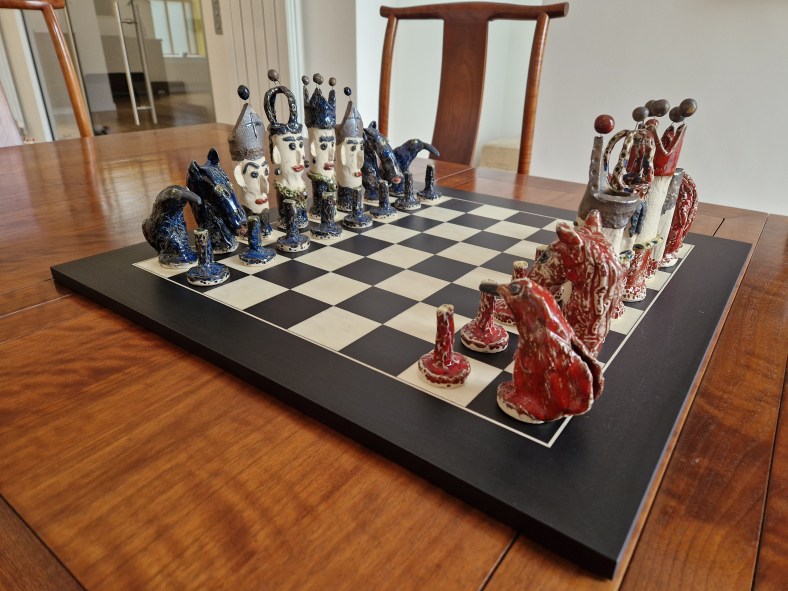
So, Claude Mythos is too dangerous to be let out of the lab, writers and artists are facing the challenge of artificial intelligence that feeds on their own creativity, and Amazon Kindle is full of AI-generated slop. So, what we need is yet another article about AI – said no one ever. But perhaps this might be a little different.
One thing that not many of my friends know about me, is that for periods in my life I have been a semi-serious chess player. I played at school, culminating in captaining the team to victory in the Kent Schools Championship, though when I went to university the discovery of girls rather took precedence. But the thing about chess is that it’s a bug that is very hard to eradicate. You think you can give it up, but it’s addictive. A drug. I’ve had periods of abstinence, but I always fall off the wagon in the end. Not that I was ever super strong; just a solid club player, happy on the lower boards of a B team.
The last couple of years, since Covid really, I haven’t been playing much. This has been mainly for logistical reasons: I grew very tired of fighting the West Yorkshire traffic to get to matches, and I’ve never been drawn to playing online. I’m old-school, over the board or nothing. But I’ve followed the elite level game, much as a tennis fan might follow Wimbledon, helped by some of the excellent online coverage of tournaments. For the last few weeks my wife has patiently tolerated my talking about the Candidates tournament (so-called because the winner gets the right to challenge for the World Championship later in the year), which was won by the brilliant 20-year-old Uzbek GM Javokhir Sindarov.
By now you’re probably wondering what any of this has to do with AI, but recently I’ve begun to realise that chess can teach us a lot about AI – especially those of us in creative fields – and it’s not all negative.
Chess has been dealing with the fallout of AI ever since Gary Kasparov lost to Deep Blue in 1997. In the last two decades chess programmes (known in the jargon as chess “engines”) have developed to the extent that anybody – amateur or professional – can run an engine on their laptop that could beat Magnus Carlsen, and it was easy to think that the game was dead: What was the point in playing a game badly when a computer could win with half its processors asleep? It certainly seemed that there was a danger when at the professional level the number of draws between players started to increase, with both sides simply playing memorised lines they’d learnt from their computers. And yet in the last few years the game has thrived to an extent not seen since the heady days of Bobby Fischer. The rise of online platforms during Covid, The Queen’s Gambit on Netflix, have all done their bit to raise popular interest in chess.
Of course AI has had an enormous effect on the game. At one level it is an invaluable training tool for players of all standards, but the danger of it being used to cheat presents challenges. At a professional level this means phones being banned and players being screened before entering the playing hall. Sudden unexpected improvements in a player’s ability raise red flags, and the online sites such as Chess.com have their own methods for spotting suspicious activity, methods they keep to themselves, reluctant to give away their secrets. But there seems to have been something of a backlash, or at least chess has learnt to put AI in its place and returned the emphasis to the human players.
In the coverage of the Candidates it has been fascinating to note that the live commentators have avoided using computers almost completely. At most they’ve known that the engine prefers the position of player A over player B, but often they have been at a loss to understand why and have simply looked at the game from the point of view of human players, not caring what the computer thinks because at the end of the day the computer wasn’t playing the game. Sometimes, in post-game analysis, a computer has shown that a player might have won had they played a particular sequence of moves, but often these moves have been described by commentators as “computery” and something no human would see or consider. That these might objectively be considered to be “better” moves is almost of zero relevance, because they are not a human response to the position.
How the players approached the games in the Candidates also reflected a subtle change. At a professional level, pre-match preparation is key; players study and learn preferred opening lines, and the preferences of their opponents, and the engines have allowed them to do this to an unprecedented degree (though apparently SIndarov himself had nine training camps in the months beforehand in which computers were not used at all). One way of getting round this has been the increase in blitz and rapid play tournaments, and a chess variant known as Fischer Random (or sometimes Freestyle or Chess960) where the starting position of the pieces is randomised, but even in regular chess – classical chess as we purists call it – there has been a change. Kevin Lincoln explained this nicely in an essay for Bloomberg. As he put it, “grandmasters are winning by making less optimal moves”. They can’t be nonsense or completely rubbish moves, but they are sidelines, or old long-forgotten variations that the computer would disregard but which enable a player to force his opponent out of their computer-aided preparation.
So what am I taking from all this? It’s true of course that the current generation of LLM AIs are a very different beast from most chess engines in how they work (though arguably AlphaZero – the strongest engine – is related to the LLMs), but while AI is a tool that can’t be ignored, it is people that are important. Nobody really cares whether one engine is stronger than another, but they do care whether Fabiano Caruana will beat Hikaru Nakamura, or whether Anish Giri could overcome Wei Yi. Later in the year the World Championship match between Sindarov and the current champion Gukesh Dommaraju will be followed eagerly. That a computer could beat either of them is of no interest, any more than it matters that a man on a motorbike could cover 100 metres faster than Usain Bolt.
I think there is hope in that.

