
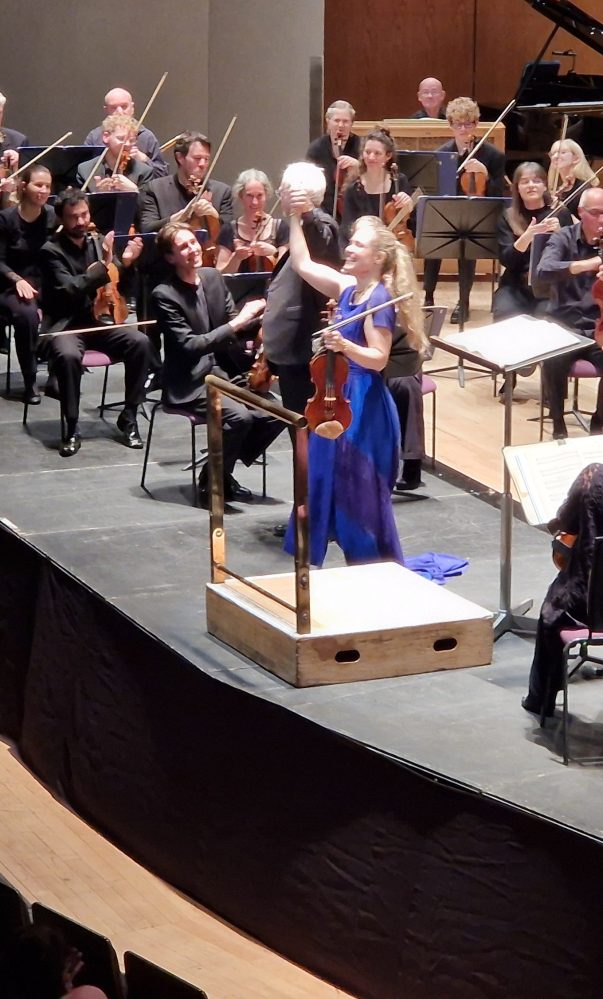
The Hallé Orchestra in Manchester has just finished a series of concerts with the American composer John Adams conducting his own music. I’ve loved his music since I first came across Shaker Loops back in the mid-1980s, to the extent that my girlfriend Isobel and I travelled all over the country if there was a chance of hearing something of his live, and his music was so little known in the UK back then that those performances were often UK premieres: Grand Pianola Music (1985) at the Almeida Festival, Harmonium (Birmingham, 1987), Harmonielehre (Huddersfield, 1987), and Nixon in China in Edinburgh (1988). It was a special time for those of us in the know, a small group of admirers who were in on a secret. In short, I’m a fan.
So, I wasn’t going to miss these concerts and they didn’t disappoint. The performance of Harmonium on the first evening was particularly special, but it was the main item in the final concert, Scheherazade.2, that triggered a series of thoughts. It’s a magnificent piece of music; a 50 minute “dramatic symphony” (Adams’ words) for violin and orchestra, played with astonishing virtuosity and commitment by its original dedicatee, the Canadian-American Leila Josefowicz, but it acted as a seed around which a number of pre-existing worries crystallised. There is a clue in the title. While in no way (I think) intended as a criticism of Rimsky-Korsakov, Adams takes a very different approach to the character of Scheherazade and the piece reflects his views of how women are treated in the present-day, in particular – though not exclusively – in those (many) societies where women are repressed.
And all that is very laudable, not something I would dream of criticising, but did it in any way affect how I heard the music? If I hadn’t read the programme note or heard Adams’ pre-concert talk, would I have realised that was what the music was about? I very much doubt it. And will it change the position of women in Afghanistan? Of course not. Don’t get me wrong, I enjoyed it enormously simply as a large-scale symphony-concerto full of drama, emotion, and colour, but as social activism? Perhaps I’m being unfair on Adams. His view of a modern-day Scheherazade may simply have been a starting point, and the brilliance of Leila Josefowicz was another, leading to what first and foremost is a wonderful piece of music, but in the pre-concert talk he spoke approvingly of today’s composers for whom the non-musical themes of their work are of critical importance, citing as examples John Luther Adams and Gabriella Smith who write music focussed on environmental issues.
And that’s where I have my concerns. I can’t comment on Gabriella Smith as I am not familiar with her music (I shall have to explore it), but for me John Luther Adams comes nowhere close to his near namesake in the quality and interest of the music itself, and no matter how praiseworthy a composer’s extra-musical intentions may be, if the ideas behind the music become more important than the music itself, then something is wrong. Adams spoke about composers for whom content was more important than style, and while it’s great that current composers don’t feel constrained to write in any one style, the content must still be primarily musical content that is interesting and memorable.
But can classical music (for want of a better term) ever function as both an art and effective activism? I have my doubts. I struggle to think of many successful examples. Mozart? Perhaps Figaro a little – we forget today how radical Beaumarchais’ play was. Beethoven? Perhaps Fidelio. The finale of the ninth, possibly. But that’s all. Brahms, Schumann, Tchaikovsky, Rachmaninov? Hardly. In the twentieth-century what pieces are there that successfully tackle societal and political (in the broadest sense of that word) issues and which have lasted in the repertoire? Tippett’s A Child of Our Time, Schoenberg’s A Survivor from Warsaw, Britten’s War Requiem, Shostakovich’s Babi Yar, Reich’s Different Trains? Perhaps there are others, but I don’t think there are many, and what these examples all share is that they have texts. (Looking at that list of pieces again, I also realise that four of the five works are a response to the consequencies of antisemitism, but that’s another topic for another day.)
As a writer and music lover I have a foot in both camps. I share Mahler’s view that music takes us to places that words alone cannot, and yet there are times also when words are necessary and the two work in combination. But even then, good motives are not enough to produce a great piece of music that will resonate over the decades.
 Words and Music