And the award goes to…

It’s that time of the year again. That lull between Christmas and New Year when news editors fall back on reviews of the year just gone and best-of lists to fill column inches. For myself, it’s an opportunity (or an excuse for self-indulgence) to look back over the concerts I’ve been to in the year, to see which ones I remember and which make me say “Did I really go to that? I don’t remember it at all.”

It was a pretty good year for those perennial favourites Mahler and Shostakovich, beginning in January with a memorable Mahler 2 in Manchester from the Hallé and their new principal conductor Kahchun Wong, while John Storgårds continued his exploration of Shostakovich with the BBC Philharmonic as well as giving us an exceptional Mahler 3 in June. Above all it was a good year for minimalists: Glass’ Satyagraha in Nice, a feast of John Adams in London, Berlin and Manchester, and Colin Currie rounding off the year with Steve Reich in Manchester.

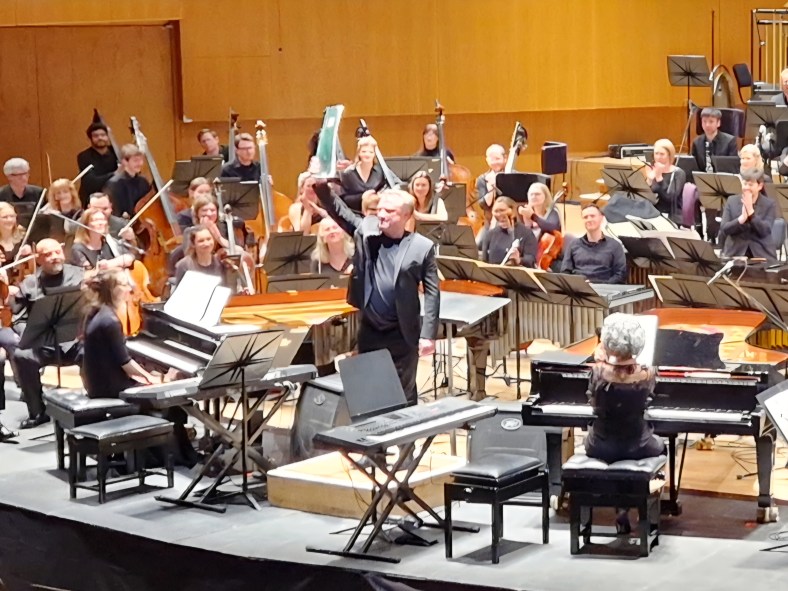
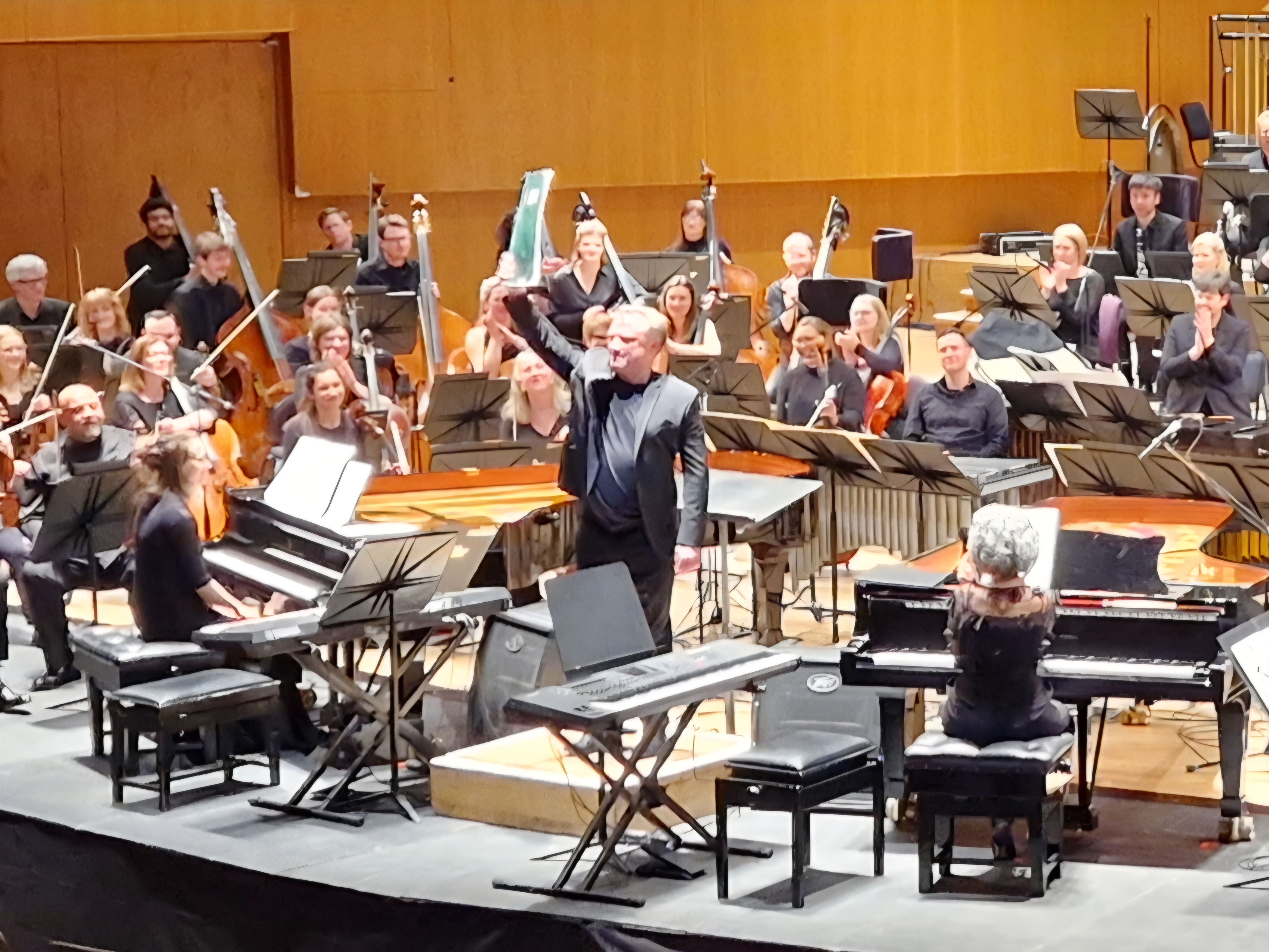
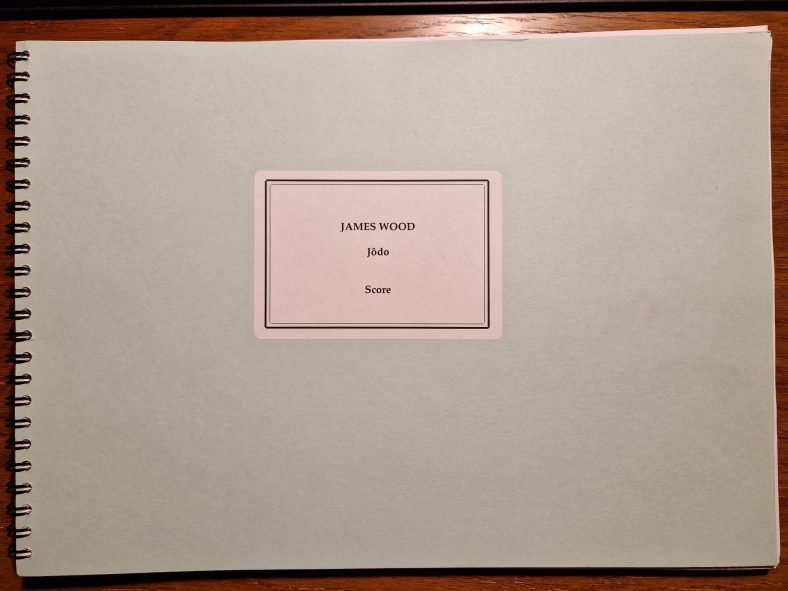
Colin Currie brandishing the score of Steve Reich’s The Four Sections

But which concerts stand out the most? Let’s get the bad out of the way first.

Most Disappointing Concert of the Year

There are a few candidates for this raspberry. Nicholas Collon is a conductor I admire enormously, and the Orchestre Philharmonique de Monte-Carlo is a fine orchestra, but their concert in April really didn’t work. On paper it was an excellent programme of Debussy, Poulenc and Bartok, but orchestra and conductor just didn’t gel. You could see it in the body language. Who knows why this sometimes happens, but it was a shame.

Still, that doesn’t take the crown. For that we have to look to the Proms. Perhaps it was my fault, perhaps I chose the wrong concerts, but of those that I went to only John Storgård’s semi-staged account of Shostakovich’s Lady Macbeth of Mtsensk District lived up to my expectations. The Arvo Pärt 90th birthday concert disappointed as well, though that may be simply that my expectations were too high, but the winner – insert sound of envelope being opened – was the Vienna Phil and Franz Welzer-Möst with Berg’s Lulu Suite and Bruckner 9. Beautifully played, of course, but oh so bland. Utterly unmemorable, but for the fact it was so disappointing.

Best Jazz of the Year

A new award this year, but it’s been a good twelve months for jazz. A couple of excellent evenings in London tacked on to visits to the Proms: Denys Baptiste led a McCoy Tyner tribute, and the Hungarian (but London-based) pianist Matyas Gayer was a discovery. Buxton may not seem an obvious jazz centre, but the Buxton Festival always has a jazz festival within, and Xhosa Cole playing Thelonius Monk was the highlight there.

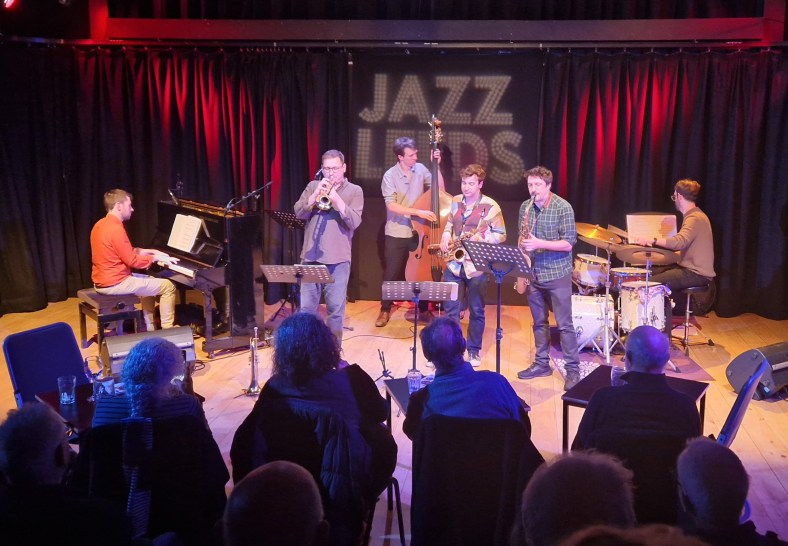
But best of all was in Leeds. I’ve always wanted to hear Misha Mullov-Abbado live, but in the past whenever he’s been playing near to where I live, events have conspired against me. This time I was not to be defeated. His latest album Effra is stunning; contemporary in feel and yet with clear links to tradition. Leading his sextet from the bass like a modern Mingus or Ray Brown, it was a wonderful evening. And yes, that name: Mullov-Abbado. Perhaps being the son of violinist Viktoria Mullova and conductor Claudio Abbado he was always destined for a life in music, but he really is supremely talented in his own right.

Misha Mullov-Abbado and friends

Most Surprisingly Enjoyable Concert of the Year

This may seem a strange category, after all, why go to a concert if you don’t expect to enjoy it?

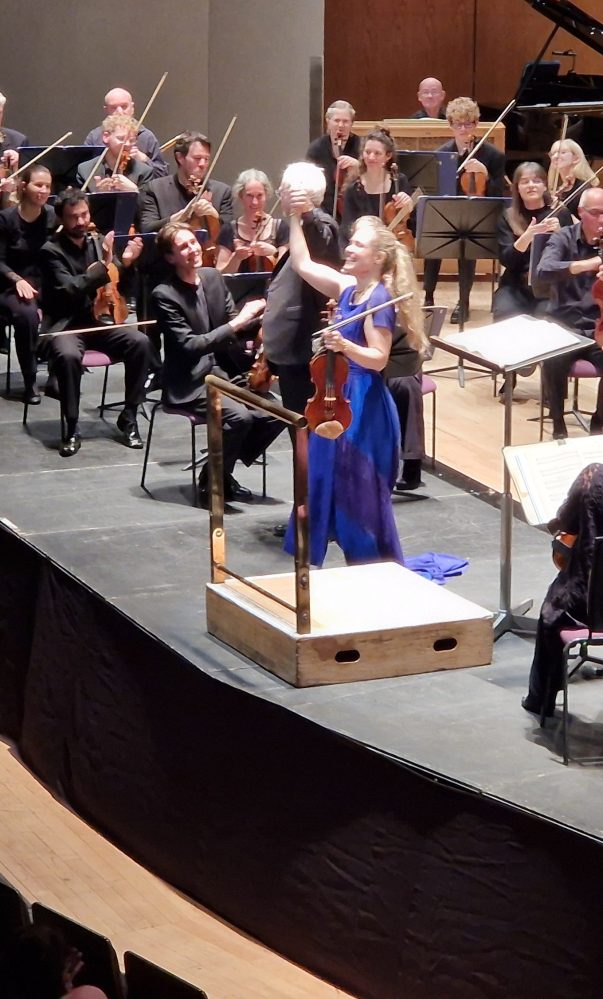
But some concerts exceed expectations, and this was the case with the Orchestra of Opera North in May at Huddersfield Town Hall. Their Huddersfield concerts are always a pleasure and they often have big-name soloists. The town hall is quite small as an orchestral venue, with the balcony wrapping itself around the stage, and the result is often a sense of intimacy that compensates for the challenge the orchestra often has trying to fit everyone on stage.

What was unusual about the May concert was that it concentrated on the core members of the orchestra. Generally, to play full-scale concert repertory they have to bring in a large number of extras, but for this programme of Prokofiev, Schumann, Anna Thorvaldsdottir and Haydn they weren’t needed. There wasn’t a conductor, with the orchestra being led from the first desk by Katie Stillman, and even the Schumann Cello Concerto was played by the principal cello, Jessica Burroughs.

Perhaps this reduced scale was a consequence of financial expediency, but the result was a tremendous sense of family and camaraderie. The players really enjoying themselves, playing for each other and showing what they could do. Ten out of ten.

Concert of the Year

Drum roll please. Time for the big reveal.

In any other year it would have to be the Berlin Philharmonic with Simon Rattle playing John Adams’ Harmonielehre. A visit to the Philharmonie had long been on my wishlist, and when a window of opportunity opened up in October I might have gone regardless of the music, but that they were playing one of my favourite pieces was an incredible stroke of good fortune and Rattle has always been an excellent advocate for Adams. It was interesting to contrast this performance with that of John Wilson and his Sinfonia of London who gave a terrific account at the Proms in 2024. Simplistically, with John Wilson there was more of an emphasis on the music’s American twentieth century credentials, with the Berliners, and in particular the depth of sound from their strings, the nineteenth century roots were more obvious.

But no, wonderful though that was, the Berliners are only runners-up.

Sleep

 I’ve written about it before so I won’t go on at length, but hearing Max Richter’s Sleep at Alexandra Palace at the beginning of September was something else. Memories that are still with me and will probably never leave. An experience unlike any other concert.

Can (Good) Music Be Political?

The Hallé Orchestra in Manchester has just finished a series of concerts with the American composer John Adams conducting his own music. I’ve loved his music since I first came across Shaker Loops back in the mid-1980s, to the extent that my girlfriend Isobel and I travelled all over the country if there was a chance of hearing something of his live, and his music was so little known in the UK back then that those performances were often UK premieres: Grand Pianola Music (1985) at the Almeida Festival, Harmonium (Birmingham, 1987),  Harmonielehre (Huddersfield, 1987), and Nixon in China in Edinburgh (1988). It was a special time for those of us in the know, a small group of admirers who were in on a secret. In short, I’m a fan.

So, I wasn’t going to miss these concerts and they didn’t disappoint. The performance of Harmonium on the first evening was particularly special, but it was the main item in the final concert, Scheherazade.2, that triggered a series of thoughts. It’s a magnificent piece of music; a 50 minute “dramatic symphony” (Adams’ words) for violin and orchestra, played with astonishing virtuosity and commitment by its original dedicatee, the Canadian-American Leila Josefowicz, but it acted as a seed around which a number of pre-existing worries crystallised. There is a clue in the title. While in no way (I think) intended as a criticism of Rimsky-Korsakov, Adams takes a very different approach to the character of Scheherazade and the piece reflects his views of how women are treated in the present-day, in particular – though not exclusively – in those (many) societies where women are repressed.

And all that is very laudable, not something I would dream of criticising, but did it in any way affect how I heard the music? If I hadn’t read the programme note or heard Adams’ pre-concert talk, would I have realised that was what the music was about? I very much doubt it. And will it change the position of women in Afghanistan? Of course not. Don’t get me wrong, I enjoyed it enormously simply as a large-scale symphony-concerto full of drama, emotion, and colour, but as social activism? Perhaps I’m being unfair on Adams. His view of a modern-day Scheherazade may simply have been a starting point, and the brilliance of Leila Josefowicz was another, leading to what first and foremost is a wonderful piece of music, but in the pre-concert talk he spoke approvingly of today’s composers for whom the non-musical themes of their work are of critical importance, citing as examples John Luther Adams and Gabriella Smith who write music focussed on environmental issues.

And that’s where I have my concerns. I can’t comment on Gabriella Smith as I am not familiar with her music (I shall have to explore it), but for me John Luther Adams comes nowhere close to his near namesake in the quality and interest of the music itself, and no matter how praiseworthy a composer’s extra-musical intentions may be, if the ideas behind the music become more important than the music itself, then something is wrong. Adams spoke about composers for whom content was more important than style, and while it’s great that current composers don’t feel constrained to write in any one style, the content must still be primarily musical content that is interesting and memorable.

But can classical music (for want of a better term) ever function as both an art and effective activism? I have my doubts. I struggle to think of many successful examples. Mozart? Perhaps Figaro a little – we forget today how radical Beaumarchais’ play was. Beethoven? Perhaps Fidelio. The finale of the ninth, possibly. But that’s all. Brahms, Schumann, Tchaikovsky, Rachmaninov? Hardly. In the twentieth-century what pieces are there that successfully tackle societal and political (in the broadest sense of that word) issues and which have lasted in the repertoire? Tippett’s A Child of Our Time, Schoenberg’s A Survivor from Warsaw, Britten’s War Requiem, Shostakovich’s Babi Yar, Reich’s Different Trains? Perhaps there are others, but I don’t think there are many, and what these examples all share is that they have texts. (Looking at that list of pieces again, I also realise that four of the five works are a response to the consequencies of antisemitism, but that’s another topic for another day.)

As a writer and music lover I have a foot in both camps. I share Mahler’s view that music takes us to places that words alone cannot, and yet there are times also when words are necessary and the two work in combination. But even then, good motives are not enough to produce a great piece of music that will resonate over the decades.

On Silence

I’ve been thinking a lot about silence lately.

Of course, as John Cage taught us, absolute silence does not exist so perhaps I need to define my terms, but silence as we commonly understand it, extreme quietness perhaps, seems to be something that most people appear anxious to avoid, almost as if they were afraid of it and feel the need to keep it at bay with empty talk, banalities that blanket the sound of time’s wing’d chariot. Restaurants – even the finest Michelin-starred establishments – play background music, train journeys are accompanied by the modern scourge of music from phones (I’ve even seen people doing that on country walks). On a recent trip to London one woman talked at (not to) her companion for three hours straight (and how did her friend feel about that?).

What is it that people are so afraid of? Their own thoughts? Do they equate, if only subconsciously, silence with emptiness? The void? The silence of the grave?

Fernand Knopff, Silence, 1890

I love silence, quietness at least, though I appreciate that this does nothing for my social life, and I am certainly no fun at parties. But silence gives space to reflect and consider, and it’s no surprise that most religious traditions recognise the value of time spent in silence. I love the way it comes in different guises, quite different from each other: the silence of late at night is the sound of the day’s energy dissipating, while the quiet of dawn – depending on the amount of birdsong! – is pregnant with possibilities. The silence of the new, the day as yet untarnished, not yet spoilt by the inanities of modern life.

It was Debussy who said that the music lies in the space between the notes. An elusive comment for sure, much like his music, but consider the tension that rests in the air between the final chords of Sibelius 5 – and the fact that they are irregularly spaced only adds to the effect – or countless examples where composers leave brief pauses. Think of a piece as well-known as the slow movement from Dvorak 9. Don’t simply listen for the famous tune, listen for the silences that are coloured by the notes that come before and after. The silence is never empty, but is shaped by what surrounds it. It is a positive absence of notes that makes it musical material in its own right.

Silence in literature is an even more complex – and paradoxical – issue than it is in music. Silence on the stage is a standard effect – Pinter being only the most famous – but how do we talk about silence in novels? Characters may be silent, and silence (hesitations, ellipses) can be a key part of writing good dialogue – and what a character doesn’t say is often more important than what they do – but can fiction itself be silent, and not merely quiet as in understated? The French writer Pascal Quignard says that “The book is a piece of silence in the hands of the reader.” I like that. I also like Graham Swift’s echo of Debussy when he wrote that “the spaces between and around words can have their unspoken resonances”. I feel sure I’m going to come back to this.

So, a plea for more silence – or at least quiet – in the world. Enjoy the aesthetic qualities of silence itself and how it is shaped by and shapes in return the world around it.

And remember Wittgenstein: whereof we cannot speak, we must be silent.